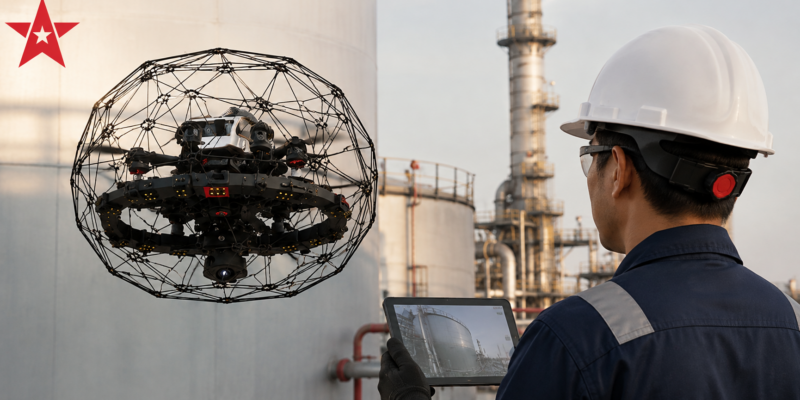
Industrial plants are growing bigger, more complex, and challenging to inspect safely. Ranging from offshore platforms and storage tanks to high-rise buildings and refinery facilities, conventional inspection methods may necessitate scaffolding, use of a rope, or shutdown, which is both costly and hazardous. Today, Drone Inspection (UTM & CVI) is transforming the manner in which industries assess vital assets by integrating aerial technology and innovative non-destructive testing technologies.
Inspectors are able to survey inaccessible zones with the help of drones that have high-resolution cameras and special sensors, and minimize disruptions in operations. Drones, alongside Ultrasonic Thickness Measurement (UTM) and Close Visual Inspection (CVI), can offer useful inspection data to aid preventive maintenance, regulatory compliance, and long-term asset reliability.
What Is Drone Inspection Using UTM and CVI?
Drone-assisted inspection is a high-tech approach to assessing industrial infrastructure that does not involve inspectors working at height or getting into dangerous areas. Inspection drones used today are able to take high-resolution visual images and complement other testing techniques to detect corrosion, coating damage, cracks, deformation, and material loss.
UTM is a method used to measure the remaining thickness of metal parts, and it is used to detect corrosion or thinning of the walls. Close Visual Inspection (CVI) is the practice of taking high-definition images, which enable the inspector to inspect the surface of welds, structural members, and equipment surfaces to identify any visible defects.
The combination of these inspection techniques with aerial access provides industries with more efficient, safer, and in-depth inspection opportunities.
How Drone-Based Inspections Work
A standard inspection is a pre-planned procedure that is aimed at producing reliable and consistent outcomes.
The inspection process will start with planning the flight path according to the layout of the assets and the inspection objectives. The drone is subsequently flown around the structure by qualified operators, and high-resolution images and videos are captured. Regions that need verification on their thickness are measured through the method of Ultrasonic Thickness Measurement (UTM), and visual inspection is aided with the help of the Close Visual Inspection (CVI) method.
The information obtained is examined through digital software, where the engineers can detect corrosion, coating failures, weld defects, structural deterioration, and other factors that can influence the integrity of the assets. Inspection reports have annotated images, measurements, and findings, and maintenance recommendations in order to make informed decisions.
Improving Industrial Asset Inspection
The Present-day Industrial Asset Inspection needs precise information provided with the least disturbance to the operations. Drone technology means that the areas that are considered expensive or hard to reach are now reachable.
Some of the common assets that are inspected are:
- Storage tanks
- Pressure vessels
- Chimneys and stacks
- Offshore platforms
- Pipelines
- Bridges
- Transmission towers
- Ship structures
- Process plants
- Industrial buildings
Since drones access high and remote locations within a relatively short time, inspections may usually be carried out within a shorter time compared to traditional methods and still achieve a high quality of documentation.
The Advantages of Drone-Based NDT Inspection
The increased use of Drone-Based NDT Inspection is attributed to the fact that it enhances not only safety but also efficiency.
Some of the key benefits include:
Enhanced Worker Safety
Inspectors do not have to spend as much time at heights, confined areas, or around dangerous equipment. This goes a long way in minimizing exposure to workplace risks.
Faster Project Completion
Much more efficient inspections of large facilities can be conducted, contributing to the minimization of shutdown time and maintenance delays.
High-Quality Digital Data
The drones take detailed pictures, video, and inspection data that can be checked numerous times without returning to the location.
Improved Maintenance Planning
Early detection of corrosion, coating wear and tear, and structural damage will enable maintenance crews to focus on repairs before they break down.
Cost Savings
Less scaffold building, rope access, and equipment unavailability will lead to the minimization of the total inspection costs.
Why Remote Industrial Inspection Is Becoming Essential
Remote Industrial Inspection is becoming increasingly popular in industries since it enables critical assets to be evaluated with reduced operational effects and flexibility.
Structures that are not easily reachable are common in facilities that work in offshore conditions, petrochemical plants, power stations, marine terminals, and manufacturing sites. Drone inspection offers engineers precise visual data without causing too much disturbance to the operations.
A digital inspection report also enhances teamwork, as the engineers, maintenance managers, clients, and regulatory agencies can access the findings remotely.
Industries That Benefit Most
Drone inspection solutions are used by a wide variety of industries in which safety, compliance, and integrity of assets are crucial.
These include:
- Oil and gas
- Petrochemical facilities
- Marine and offshore activities.
- Power generation
- Renewable energy
- Manufacturing plants
- Infrastructure and construction
- Ports and terminals
- Water treatment facilities
- Mining operations
The advantages of these industries are that the inspections are faster, there is enhanced documentation, and enhanced maintenance planning over the lifetime of the assets.
Best Practices for Successful Drone Inspections
Organizations should make sure that inspections are conducted by trained persons with the use of approved procedures in order to maximize the accuracy of inspections and adherence to regulations. The weather conditions, limited airspace, and access to assets should be taken into account during flight planning. Regularly, equipment is to be calibrated, and inspection data is to be safely stored in order to analyze and compare them in the future.
The integration of aerial inspection with additional NDT techniques can be used to generate more accurate results and assist in long-term asset management solutions.
Frequently Asked Questions
Q1. What is Drone Inspection (UTM & CVI)?
Ans: It is a type of inspection that involves a combination of drone technology, ultrasonic thickness measurements, and close visual inspection to inspect industrial assets safely, efficiently, and without causing much disruption to operations.
Q2. What is the benefit of Ultrasonic Thickness Measurement?
Ans: UTM is used to measure the remaining thickness of metal parts to allow inspectors to detect corrosion, erosion, and loss of the wall prior to structural integrity being damaged.
Q3. Why do we use Close Visual Inspection?
Ans: CVI is a high-resolution image that is employed to identify visible defects that include cracks, corrosion, coating damage, weld defects, and mechanical damage.
Q4. Which are the industries employ drone-based industrial inspections?
Ans: Drones are widely used in oil and gas, marine, offshore, power generation, manufacturing, infrastructure, construction, mining, and petrochemical industries through inspections that are assisted by drones.
Q5. What is the reason why drone inspections are more efficient than traditional ones?
Ans: They minimise the use of scaffolding, rope access, and prolonged shutdowns, offer quick access to inaccessible places, and generate detailed digital inspection records.
Conclusion
As industrial facilities continue to prioritize safety, efficiency, and predictive maintenance, Drone Inspection (UTM & CVI) has become an important part of modern asset integrity programs. Incorporating aerial technology and modern inspection methods like Ultrasonic Thickness Measurement (UTM) and Close Visual Inspection (CVI) can speed up the process of inspecting critical infrastructure by organizations, minimize risk to people, and enhance maintenance planning. In industries that require reliable Industrial Asset Inspection, A-Star Testing & Inspection provides professional inspection testing that assists in safeguarding valuable assets, regulatory compliance, and operational stability in a wide variety of industries.